top of page

10 Commandment Memory Hand Trick

  • Jan 26
  • 6 min read

Updated: Feb 9


Commandment 1


Hold up one finger.


This simple hand sign helps reinforce the truth behind God’s first (1st) commandment:


There is only one true God.


Teaching Note: Use this moment to talk about what it means to put God first. Explain that the Bible teaches us not to place anything before Him—because He alone is God. Keeping one finger raised becomes a visual reminder that God comes first in our hearts, our choices, and our lives.


Teaching Note: Use this moment to talk about the difference between honoring something and worshiping it. Explain that while many things in our lives can be important, only God belongs in the highest place. As one finger stays upright while the other bends, it becomes a visual reminder that nothing we make or trust should take God’s place. God alone deserves our worship.

Commandment 2


*Hold up one finger on both hands.


*Hands face one another.


*One finger bends while the other stays raised.


*Alternate fingers "bowing down".


These hand motions help reinforce the truth behind God’s second (2nd) commandment:

Do not worship other gods.
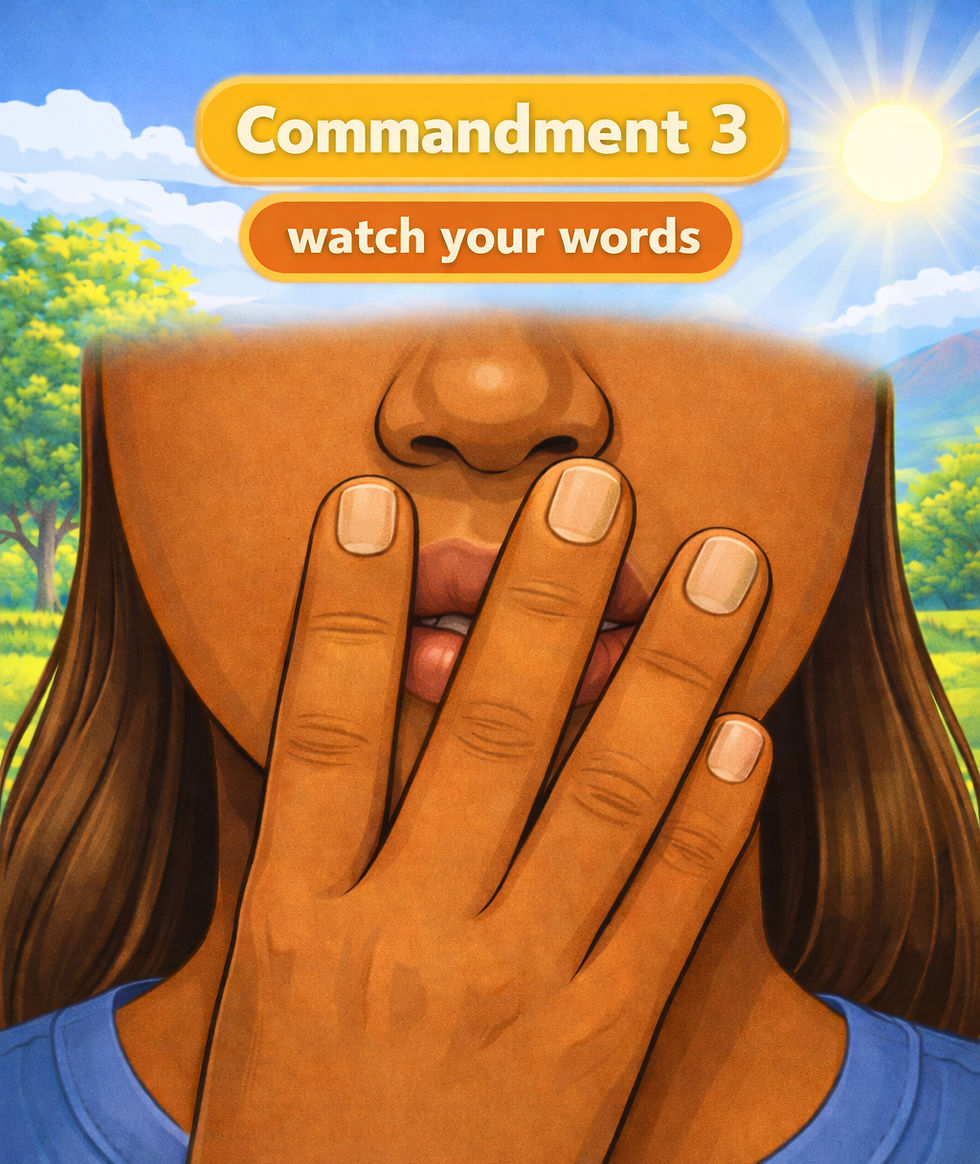

Teaching Note: Use this moment to talk about why our words matter to God. Explain that this commandment invites us to pause before we speak and think about whether our words honor Him. Covering the mouth with three fingers becomes a visual reminder that even our everyday words should reflect respect for God and care for others.

Commandment 3


*Hold up three fingers. 


*Gently place them over your mouth.


*Softly tap on your lips while saying aloud, "Watch Your Words".


This hand sign resembles the letter 'W'. Placing it over our mouths helps us remember to pause before we speak.


The gentle tapping helps remind of God's third (3rd) commandment:


Do Not Use the Lord's name in vain.


Teacher Note: Use this moment to talk about why God invites us to rest. Explain that the Sabbath is a gift meant to help us slow down, spend time with God, and be present with the people around us. This visual can remind students that honoring the Sabbath isn’t just about a day on the calendar, but about choosing to set time apart for God in our everyday lives.

Commandment 4

*Hold up two fingers on both hands.


*Turn both hands to face each other.


*The fingers come together to form a house.

(Connect the thumbs to create the floor.)


This hand sign reminds us to set a special time apart to rest, honor God, and honor His fourth (4th) commandment:

Remember the Sabbath and keep it holy.


Teacher's Note: Use this moment to talk about what it means to honor parents in everyday life. This can include listening, showing respect, helping at home, and speaking kindly. The high-five reinforces that honor is active and relational—it’s something we practice through our actions, not just something we say.

Commandment 5

*Hold up five fingers

During this motion, recite the first half of the commandment, "Honor your mother and father..."


*Clap hands together in a high-five motion. This is the first commandment with a promise. Complete the second motion with the 2nd half of the commandment.


These hand signals help us remember that God's fifth (5th) commandment:

Honor your parents and your life will be long.


Teacher's Note: Use this moment to talk about how this commandment goes beyond physical harm and connects to how we treat others every day. You can help students understand that choosing kind words, controlling anger, and caring for one another are ways we honor the value God places on life. This conversation can gently guide students toward making choices that bring peace, respect, and safety to their relationships.

Commandment 6

*Show six fingers


*Take the hand with 1 finger and push it into the other hand


*Allow the 5 fingered hand to be "killed" by the 1-fingered hand (the knife)


Our choices, words, and actions matter because people are important to God.


This set of hand motions reminds us to protect life and choose love over harm by remembering God's sixth (6th) commandment:

Do not murder.

Teacher Note: Use this moment to talk about what faithfulness looks like in everyday life. This can include keeping promises, being honest, and choosing respect in how we treat others. You can help students see that God’s instructions are meant to protect hearts and relationships, guiding us toward choices that build trust and honor one another.

Commandment 7

*Hold up 7 fingers.

(5 on one hand and 2 on the other)


*Cross both fingers on the hand holding up 2 fingers.


God calls us to be faithful and to respect relationships. The crossed fingers represent a relationship or promise made between 2 people. This agreement does not involve the 5 fingers (people) standing alone on the other hand.


It is important to understand that God’s design for relationships is built on trust, faithfulness, and respect. This is God's seventh (7th) commandment:


Do not commit adultery.

Teacher Note: Use this moment to talk about honesty in everyday situations. Help students understand that stealing isn’t just about taking physical items, but also about cheating, lying, or keeping what isn’t ours. Emphasize that God wants our hearts to choose what is right even when no one is watching.

Commandment 8

*Hold up 8 fingers.

(4 fingers on each hand)


*Pretend to grab with both sets of hands.


God cares about honesty and fairness, and He teaches us not to take things that don’t belong to us. Remember that stealing doesn’t always look the same—it can happen with objects, words, time, or choices.


This hand motion helps us remember to respect what belongs to others and to live with integrity. This is God's eighth (8th) commandment:

Do not steal.

Teacher Note: Use this moment to talk about how words can help or hurt others. Explain that bearing false witness doesn’t just mean lying in court, but also includes exaggerating stories, spreading rumors, blaming others unfairly, or saying things that aren’t true about someone. Ask students to think about times when telling the truth was difficult and why honesty still matters. Remind them that God values truth because it protects people, builds trust, and reflects His character.

Commandment 9

*Show the number nine using your hands.

(5 fingers on the right hand; 4 fingers on the left hand.)


*Place the left-hand palm down as though it's resting on a Bible in court.


*Leave the right hand raised in the air.


God values honesty and wants our words to reflect love and truth. As believers this hand sign helps us remember that telling the truth builds trust and helps relationships grow strong.


Our words matter and should be used wisely according to God's ninth (9th) commandment:

Do not lie.

Teacher Note: Use this moment to talk about how wanting something isn’t always wrong but wanting what someone else has can quietly sneak into our hearts. Ask students if they’ve ever wanted a toy, a game, or something a friend had. Explain that coveting starts on the inside — before any action happens. God cares about our hearts, not just our behavior. Remind students that gratitude helps guard our hearts, and trusting God means believing He gives us exactly what we need.

Commandment 10

*Hold up both hands with all ten fingers extended


*Turn both hands palm up


*Slightly cupped the fingers in and out,

as if reaching for or wanting something


Coveting means wanting what someone else has instead of being thankful for what God has given us. this commandment is about our hearts, not just our actions.


This hand sign is a reminder that gratitude helps us stay joyful and content. It also reinforces that we should trust Him and appreciate His gifts. Love happens when we remember God's tenth (10th) commandment:


Do not be greedy (covet).


© 2026 Rooted & Suited. All rights reserved.

This resource is licensed for personal, classroom, church, and ministry use only. Permission is granted to print and share within your organization. This content may not be sold, redistributed, or uploaded to other websites, platforms, or marketplaces without written permission from Rooted & Suited.

Created by Rooted & Suited — faith-filled resources designed to help children learn God’s Word through movement, visuals, and hands-on engagement.

Comments


Phone: 423*468*3893                                                                                                                         Email: rnsoutreach@gmail.com

  • Facebook
  • YouTube
  • TikTok

© 2026 Rooted & Suited Youth Outreach All rights reserved. This resource is licensed for use within your organization or ministry. It may be printed and shared for educational purposes, but may not be reproduced, sold, or redistributed without permission.

bottom of page